Open-weight models Kimi K3 and GLM-5.2 now match closed-sourced frontier performance. Here's what that means for you.

For most of the last two years, choosing a model meant choosing a side. You could pay frontier prices to Anthropic or OpenAI for the best output, or you could run an open-weight model you actually owned and save money, knowing you were giving up a few points of capability to do it. The best models were closed. The open ones were good enough for some jobs.
It's fair to say that this is no longer the case. In the past five weeks, two open-weight releases have pulled close enough to the frontier that the old trade-off barely holds, and the developer community has noticed. Both launches drew real buzz: countless Twitter threads, Reddit discussions, vibe coding tests, and more serious conversations from teams asking whether they should switch.
Here is why the excitement is warranted.
On capability: Moonshot AI's Kimi K3 scores 57 on the Artificial Analysis Intelligence Index, a composite of nine evaluations. That puts it above Claude Opus 4.8 and just 2-3 points behind the top-ranked models (Fable 5 and GPT-5.6 Sol). Z.ai's GLM-5.2 follows with a score of 51.
On price: GLM-5.2 runs at roughly $0.47 per AA Index task, about one sixth of Claude Fable 5's $2.75. Kimi K3 lands at $0.95, still under GPT-5.6 Sol ($1.04).
So the gap in quality is now three points, and the gap in price is still 3x to 6x. That combination justifies the fanfare around these two models in the developer community.
Who are Z.ai and Moonshot AI?
Z.ai, formerly Zhipu AI, spun out of Tsinghua University's Knowledge Engineering Group in 2019. Its GLM (General Language Model) family goes back to ChatGLM-6B, one of the most-forked open models of 2023. In January 2026 it became the first Chinese frontier AI lab to go public, listing in Hong Kong at a $6.55 billion valuation. Its market cap has since climbed past $100 billion, more than 15x its IPO level.
Moonshot AI, founded in 2023 by Tsinghua alumni and backed by Alibaba and Tencent, raised $2 billion at a $20 billion valuation in May 2026, a round driven in large part by demand for its open releases.
These are well-funded research labs with multi-year model lineages, and they ship open weights as a long-term strategy.
What they actually shipped
Z.ai shipped GLM-5.2 in mid-June under an MIT license, API live on June 16. A month later, on July 16, Moonshot AI announced Kimi K3, with API access at launch and full weights arriving on Hugging Face by July 27.
GLM-5.2 is a 744-billion-parameter mixture-of-experts (MoE) model with about 40 billion active parameters per forward pass, a 1-million-token context window, and up to 128K output tokens. The MIT license puts no strings on commercial use or derivatives.
Kimi K3 is a 2.8-trillion-parameter MoE model, the first open model to reach the 3-trillion class. It shares the 1-million-token context window, adds image input, and ships weights in MXFP4 format (about 1.4 TB on disk). The license is expected to be Modified MIT, matching earlier Kimi releases, with final terms landing alongside the weights on July 27.
Quick primer: open weight is not the same as open source.
These terms get used interchangeably, but knowing the difference will inform what you can build with these models. Open weight means the trained parameters are published: you can download and run them on your own hardware, or fine-tune and serve them through any provider. You don't get the training data, the training code, or the recipe to rebuild the model. Open source goes further: the training data, the training code, and the recipe to reproduce the model from scratch are all published too. GLM-5.2's unrestricted MIT license comes close in spirit. Kimi K3's expected Modified MIT adds conditions worth reading before you commit. For most teams, open weight is the property that counts: it's the line between a model you own and a model you rent.
The benchmarks
On the Artificial Analysis Intelligence Index:
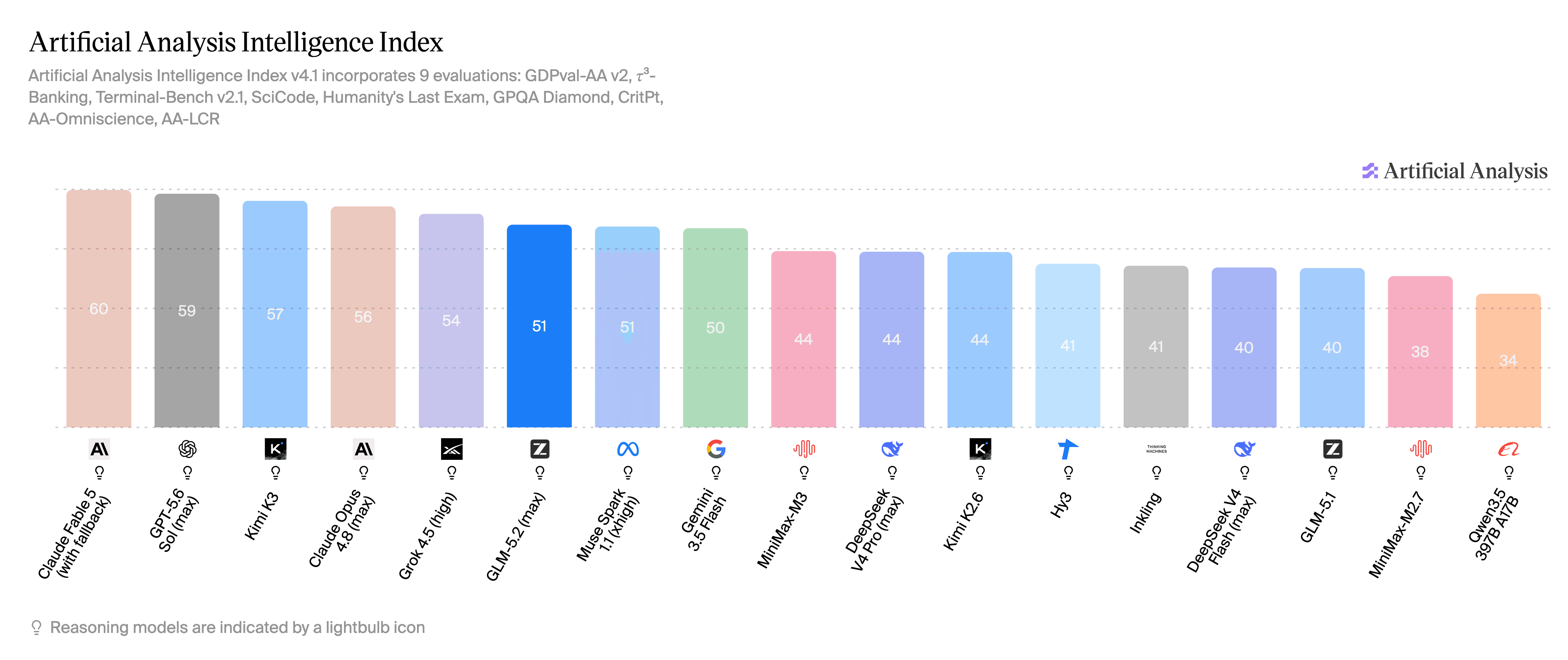
(Source: Artificial Analysis)
Kimi K3 sits above Claude Opus 4.8, Anthropic's flagship until Fable 5 shipped. Three points separate it from the best model on the board.
Human preference points the same way. On Arena.ai's Frontend Code leaderboard, where developers vote on head-to-head outputs without knowing which model produced them, Kimi K3 holds the #1 spot at 1,679, ahead of Claude Fable 5 (1,631), GPT-5.6 Sol (1,618), GLM-5.2 (1,587), and Claude Opus 4.8 (1,562).
Both labs also publish their own coding-agent numbers, and they generally track independent benchmarks. Z.ai reports GLM-5.2 at 62.1 on SWE-bench Pro, ahead of GPT-5.5's 58.6, and 81.0 on Terminal-Bench 2.1, within four points of Claude Opus 4.8's 85.0. Moonshot reports Kimi K3 at 88.3 on Terminal-Bench 2.1 and 67.5 on DeepSWE.
One caveat: vendor-reported benchmarks are typically measured under harnesses the vendors chose, and third-party verification of K3 is still catching up. Weigh these benchmarks and their sources accordingly in your evaluation. At the end of the day, no single benchmark will determine which model works best for your workflows and goals.
Intelligence per dollar
Official API pricing from model providers sheds an even more impressive light on Kimi K3 and GLM 5.2:
Model | Input | Output |
|---|---|---|
$1.40 | $4.40 | |
$3.00 | $15.00 | |
$5.00 | $25.00 | |
$5.00 | $30.00 |
Artificial Analysis rolls this into a weighted cost per Index task: GLM-5.2 at $0.47, Kimi K3 at $0.95, GPT-5.6 Sol at $1.04, Claude Fable 5 at $2.75:
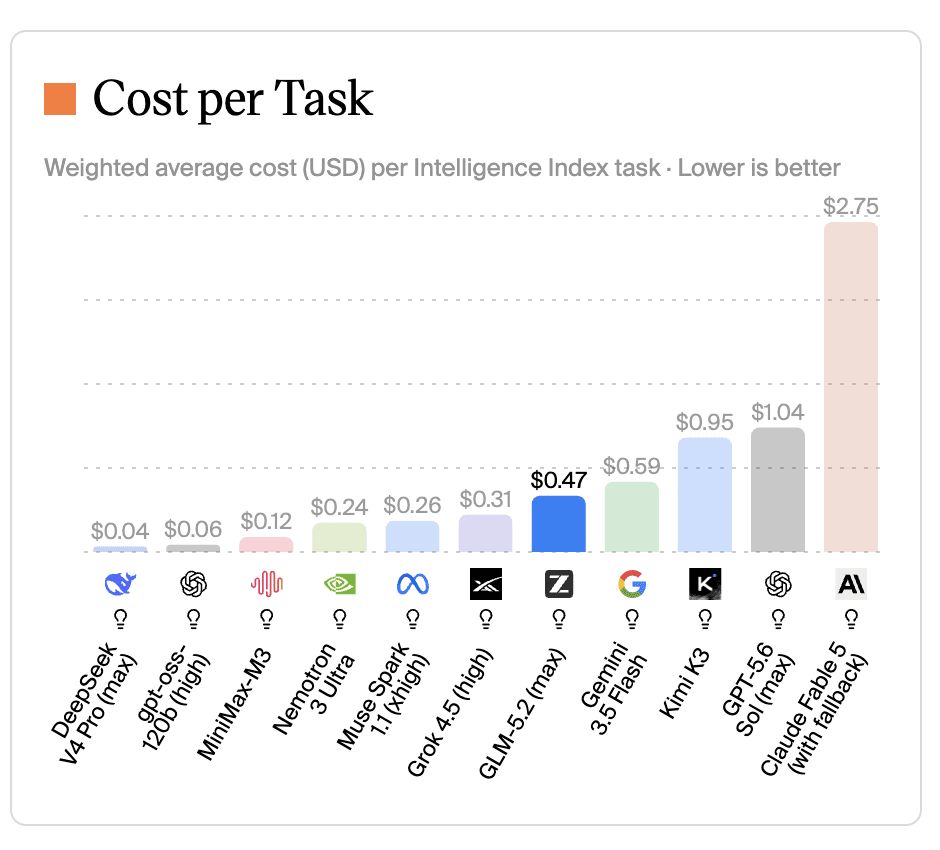
(Source: Artificial Analysis)
The takeaway: GLM-5.2 delivers 85% of Fable 5's intelligence score for 17% of the cost per task. Kimi K3 reaches 95% for 35% of the cost. And because the weights are open, those API prices are a ceiling, not a floor: any provider can serve these models, and competition drives the number down in a way closed models never allow.
The field is getting more crowded, fast
As if the week needed more excitement after Kimi K3: on July 19, three days later, Alibaba previewed Qwen 3.8, a 2.4-trillion-parameter multimodal MoE model that Alibaba says is "second only to Fable 5." It's in preview now at roughly 10% of standard pricing, with an open-weight release promised soon. Alibaba has not released any benchmarks yet, but the community reaction is undeniable, and the competition is heating up fast.
What it means for you
If you build AI applications, this is the good news. Your model menu expanded at the top of the capability range, and your unit economics improved with it. When inference is one of your biggest variable costs, cutting it 3x to 6x at near-parity quality might be the difference between losing money per user and running a sustainable business. Even if you stay on a frontier API, more credible options mean more leverage on price.
If you run a large team locked into one expensive provider, diversifying no longer means dumbing down. At a three-point gap, routing the bulk of production traffic to an open-weight model and reserving frontier calls for the genuinely hard cases isn't a compromise. It's good architecture and a sound business decision.
If you mostly use AI through consumer apps, the story is more nuanced. Take Fable 5 as the example. It launched June 9, went dark for three weeks under an emergency export-control order, then came back July 1 to genuine relief from users who'd missed it. Anthropic even extended included access on Pro and Max plans into mid-July before switching to metered usage credits. All of that attention, and yet at $10/$50 per million tokens the model stays out of reach for most people once the included window closes. The daily surfaces still belong to OpenAI and Anthropic (ChatGPT, Claude, Cowork, the Codex app), so a raw open-weight model won't replace your everyday tool tomorrow.
What has changed is that frontier-level performance is now available at a fraction of the price for anyone willing to reach for it. That is the exciting part, and it's exactly what Pioneer Model Router is built for: instead of committing your whole workflow to one expensive model, it sends each request to the model that fits, cheap and open for the routine work, frontier for the hard edges, all inside the same setup. More flexibility, better economics, no lock-in.
Underneath all of it sits the shift that outlasts any single leaderboard: open weights make the model an asset you own. Your fine-tuned variant, your data, your weights, none of which was ever on the table with a frontier API.
Try open-weight models on Pioneer
GLM-5.2 is live for inference on Pioneer right now, and Kimi K3 will be soon. Already using an OpenAI or Anthropic client? Point it at one new base URL and you're up and running in no time.